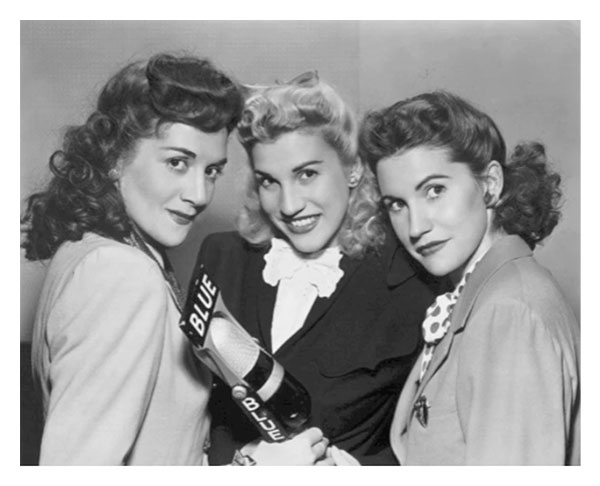
The Andrews Sisters were the most sought-after singers in theater shows worldwide during the 1940s and early 1950s, always topping previous house averages. The trio headlined at the London Palladium in 1948 and 1951. They hosted their own radio shows for NBC's Blue network, along with ABC and CBS from 1944 to 1951, singing specially written commercial jingles for such products as Wrigley's chewing gum, Dole pineapples, Nash motor cars, Kelvinator home appliances, Campbell's soups, and Franco-American food products. The western-themed The Andrews Sisters' Show (subtitled "Eight-to-the-Bar Ranch"), co-hosted by Gabby Hayes, began in 1944 and featured a special guest every week. The sisters' popularity was such that after the war, they discovered that some of their records had been smuggled into Germany after the labels had been changed to read "Hitler's Marching Songs." Their recording of "Bei Mir Bist Du Schön" became a favorite of the Nazis, until it was discovered that the song's composers were of Jewish descent. This did not stop concentration camp inmates from secretly singing it, this being most likely because the song was originally a Yiddish song, "Bei Mir Bistu Shein," and had been popularized within the Jewish community before it was recorded as a more successful "cover" version by the Andrews Sisters.
—Wikipedia
RCA had acquired radio station WJZ in New York and WRC in Washington, DC, and had been using Western Union's transmission lines for its "work" transmissions, albeit at somewhat degraded quality, compared to the superior telephone lines of AT&T (apparently "his master's voice" wasn't nearly as audible over Western Union's telegraph lines as over AT&T's phone lines). RCA solved this problem by simply buying out the competition in time-honored American Business tradition. Thus having acquired its own monopoly, RCA formed NBC two months later in September of 1926 with an initial network of 19 stations.
In fact, NBC operated two networks: NBC Blue, headed by station WJZ, and NBC Red, headed by WEAF. This situation arose due to NBC then owning two stations in New York (WEAF and WJZ). WEAF and the "Red" Network became the flagship network and offered most of the established shows and advertisers, and the "Blue" Network carried most of the sustaining shows (e.g., shows without regular sponsors). How did they arrive at the names "Red" and "Blue?" The felt tip marker pen used to trace the routes of the WJZ-headed stations was blue, and as you may have already guessed, the marker used to trace the WEAF-headed stations was red. This was a confusing situation for everyone but NBC and its sponsors and advertisers, and that was just fine by NBC, thank you.
If that isn't confusing enough, NBC also operated three other "color" networks: NBC Orange, NBC Gold, and NBC White. NBC White was NBC's Religious Programming network, also referred to as The Watchtower Network, and operated from about 1928 to 1936. NBC’s Orange Network was its West Coast affiliates, KGO, KFI, KGW, KOMO, and KHQ, beginning operations in 1931. NBC also operated a "Gold Network" comprised of KPO, KECA, KEX, KJR, and KGA, disbanded and absorbed by the Orange Network in 1933.
Those of us who catalog our Golden Age Radio collections generally refer to NBC Red as NBC, and simply include NBC Blue as NBC up until NBC sold the Blue Network to the American Broadcasting Company. Indeed, NBC's Blue Network became ABC in 1943, due to a landmark Supreme Court Ruling that stated NBC had specifically maintained the two parallel networks for the express purpose of stifling competition. NBC extricated itself from this sticky situation by subsequently selling NBC Blue to Edward Noble of the Lifesaver Candy Company, who first called it simply "The Blue Network," then "The Blue Network of the American Broadcasting Company," and eventually in 1945, dropped the Blue Network appellation completely after which time the old Blue Network was simply called the American Broadcasting Company (ABC).
|